Musical Toys in Your Baby’s First Year: A Gentle Guide (0–12 Months)
25 December 2025

A baby’s first year is full of new sounds: a parent’s voice, a lullaby hummed at bedtime, the clink of a spoon, a grandparent singing on a video call from far away. Babies notice these sounds long before they can name them, and many parents find that gentle music becomes a lovely part of the day, at feeding time, at bath time and in the quiet minutes before a nap.
This guide looks at musical toys through the first twelve months: what parents often notice at each stage, which kinds of sound toys suit which age, and how to keep musical play calm, safe and shared. It is not a promise that any toy will teach your baby something. The most important “musical instrument” in your home is still your own voice.
Why sound matters in the first year
- Babies take in the world through their senses: sound, touch, movement, faces and closeness.
- Repetition makes things familiar. A song heard every evening soon becomes part of the routine.
- Talking, cuddling, singing and playing together are the heart of it. Toys are simply one way to add a gentle sound to those moments.
What counts as a musical toy for a baby?
Musical toys are baby-friendly toys that make gentle sounds, melodies, lullabies or rattling noises. Common types include:
- Soft musical plush toys
- Rattles
- Crib and stroller sound toys
- Press-to-play sound toys
- Musical play mats
- Lullaby and devotional sound toys
What parents often notice, month by month
Every baby grows at their own pace, so treat these as loose observations rather than milestones to tick off.
0–3 months: familiar voices and soft sounds
- Newborns often settle to familiar voices and soft, steady sounds heard regularly at home.
- Some babies blink, go still or turn slightly towards a sound.
- A lullaby repeated at the same time each day can become a comforting signal that it is time to wind down.
3–6 months: turning towards sound
- Babies become curious about where sounds come from and may turn their heads towards music or voices.
- A light rattle gives them the fun of making a sound themselves.
- Many babies smile, wriggle or kick when a familiar tune starts.
6–9 months: “I did that!”
- Babies start to notice that pressing, shaking or patting something makes a sound, and they love to repeat it.
- Press-to-play toys and play mats tend to become favourites around now.
9–12 months: rhythm and anticipation
- Babies may clap, bounce or sway to music.
- They often anticipate the next part of a familiar song or game, which makes shared musical routines a real joy.
What gentle musical play can add to your day
A calming routine
Soft music at the same point each day, after the bath or before a nap, gives the day a gentle rhythm. Many families use a lullaby, a bhajan or a mantra their own parents sang to them.
The fun of cause and effect
Shaking a rattle or pressing a soft tummy to hear a sound is simple, satisfying play for older babies, and they will happily do it again and again.
Bonding
Musical play is an easy invitation to sing along, clap, make faces and respond to your baby’s reactions. That shared attention is the part babies enjoy most.
Familiar sounds from home
For families living far from India, a toy that plays the mantras or prayers heard in a grandparent’s home can carry a little of that atmosphere into a nursery in London, Toronto or Sydney.
Which musical toys suit which age
| Age | Musical toy | Why parents like it |
|---|---|---|
| 0–3 months | Your voice, soft music played nearby | Familiar, gentle sound |
| 3–6 months | Light rattles | Easy to hold and shake |
| 6–9 months | Press-to-play toys | Making sounds happen |
| 6–12 months | Musical play mats | Movement and sound together |
| 0–12 months | Crib or stroller sound toys | Something to listen to and watch, supervised |
| 12 months and up | Soft musical plush, sound books | Cuddles, routine and press-to-play fun |
What to check before you buy
- Gentle volume. Choose soft, soothing sound over loud electronic noise, and keep the toy at a comfortable distance from little ears.
- Baby-safe materials. Soft fabric, smooth edges, firm stitching and no small parts that could come loose.
- Safety certification. Look for recognised toy-safety standards such as ASTM (US) or EN-71 (Europe).
- Age guidance. Follow the age on the label. Many plush toys are designed for ages one and up.
- Easy to clean. Babies mouth and cuddle everything, so check the care instructions.
- Light and easy to hold. Smaller, softer toys are easier for small hands.
- Sounds you love too. You will hear the toy many times a day. Choose lullabies, mantras or melodies that feel meaningful to your family.
A few gentle habits
- Sing along with the toy rather than leaving it to play on its own.
- Keep sessions short and watch your baby’s cues: turning away or fussing usually means “enough for now”.
- Avoid lots of sounds at once. One gentle sound at a time is plenty.
- Keep soft toys out of a baby’s sleep space. Use music before sleep, then put the toy away.
- Choose real, shared play over screen-based music where you can.
Mantra chanting plush from Panda’s Box
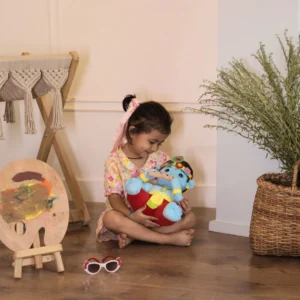
Our mantra chanting plush toys play traditional mantras and aartis at a gentle volume when you press the tummy. They are designed for ages 1–5 and certified to ASTM and EN-71 toy-safety standards. For babies under one, enjoy them together, supervised, as part of a calming routine, and keep them out of the cot at sleep time.
A small plush is about 23 cm, light enough for little hands: the small Baby Ganesha and small Baby Krishna are popular first choices. For a toddler, My First Book of Mantras is a press-to-play sound book with a volume slider.
Frequently asked questions
What kind of musical toy suits a newborn?
In the early weeks, your voice and soft music played nearby are all a newborn needs. Light rattles and press-to-play toys come into their own from a few months on. Always follow the age guidance on the label.
Can musical toys help with bedtime?
Many parents like to play the same gentle song or mantra as part of a wind-down routine. Use it before sleep, then move the toy out of the sleep space.
How long should babies play with musical toys?
Short, supervised sessions spread through the day work well, mixed with talking, cuddling, tummy time and face-to-face play.
Looking for a gentle first sound toy? Browse our mantra chanting toys or the small plushies, which are just the right size for little hands.