Musical Toys for Infants: Gentle Sound, Routine and Bonding in the First Year
31 October 2025

In the first year, babies take in the world through everyday moments: faces leaning in close, voices they know, songs at bath time, the clatter of the kitchen. Sound is a big part of that world, which is why so many parents look at musical toys for infants and wonder which ones are worth having.
The honest answer is reassuringly simple. A musical toy is not a teacher. At its best, it is a small prop for something that matters far more: you and your baby sharing a calm, happy moment together. A gentle melody, a familiar chant, or a parent singing along during play can become a cherished part of the day.
What sound means to a baby
Familiar voices
Many parents notice their newborn settling at the sound of a familiar voice, or turning towards it. Your voice, talking, humming or singing, is the most meaningful sound in your baby’s world, far more than any electronic tune.
Rhythm and routine
Babies seem to find comfort in predictability. A song you sing every bath time or a lullaby you hum every night soon becomes a signal that says “this is what happens now”. Short, repeated melodies are easy for little ones to recognise, and that familiarity is what makes them soothing.
Sound as a shared moment
Babies watch your face closely while you sing: your expression, your smile, the rhythm of your words. That is why musical play is at its best as a shared experience, with eye contact and a little back-and-forth, rather than background noise.
What to look for in a musical toy for a baby
- Gentle sound, not loud noise. Babies’ ears are sensitive. Soft melodies at a low volume feel calm; loud, sudden or harsh sounds can startle.
- Simple, repeatable audio. A short tune or chant that plays the same way every time is easier to recognise than a busy medley of jingles.
- Press-and-hear, as babies grow. Older babies love discovering that pressing something makes a sound happen. Keep it simple: one press, one gentle response.
- No flashing lights or constant noise. Babies also need quiet. A toy that plays for a short time and then stops is easier to live with than one that never switches off.
- Safe construction. Secure stitching, no beads or small detachable parts, a properly secured battery compartment, and an age label that matches your child.
- Easy to clean. Babies mouth everything, so choose a toy you can keep clean.
- Easy for you to use. No fiddly controls. If it is simple, you will actually use it.
Musical toy play vs background music
| Background music | Musical toy play together | |
|---|---|---|
| Interaction | Mostly passive listening | Parent and baby play together |
| Baby’s part | Limited | Pressing, reaching, reacting |
| Connection | Sets a mood | Shared, face-to-face moments |
| Senses involved | Mainly hearing | Sound, touch and sight together |
| Routine | Can be calming | Easy to turn into a daily ritual |
Both have their place. A soft playlist can make the evening feel calm; a few minutes of singing along with a musical plush is a moment you share.
Sound and play through the first year
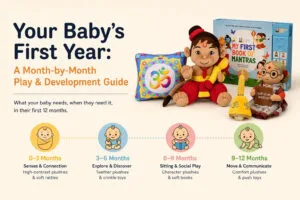
| Age | What many babies enjoy | Sound play ideas | Your role |
|---|---|---|---|
| 0–3 months | Familiar voices, soft lullabies | Singing and humming close to your baby | Hold, talk, comfort |
| 3–6 months | Turning towards sounds | A soft rattle, gentle songs with actions | Eye contact and repetition |
| 6–9 months | Reaching for things that make a noise | Simple sound toys, clapping games | Supervised exploring |
| 9–12 months | Pressing to make something happen | Press-and-play toys, sing-along routines | Guide play and build routines |
Every baby is different, so treat these as loose ranges and follow your own baby’s lead.
Simple ways to make musical play special
- Keep it short. A few minutes is plenty. Quality matters more than duration, and babies need quiet time too.
- Pair sound with eye contact. Get down to your baby’s level and let them see your face as you sing.
- Repeat the same song. You may tire of it long before your baby does, and that familiarity is part of the comfort.
- Pause and let your baby respond. A kick, a smile or a coo is their side of the conversation.
- Make it a routine cue. One song for bath time, one for bedtime. Over time it becomes part of how the day winds down.
- Add your own voice. Sing along, even if you think you cannot sing. Your baby will not mind.
For families raising children far from India, this is also a lovely way to share the sounds of home: the lullabies, bhajans and mantras you grew up with, sung in your own voice.
Common myths about musical toys
“More features mean more fun”
Not for babies. Simple toys with one gentle sound are often enjoyed far longer than busy toys with lights, buttons and dozens of tunes.
“Louder keeps babies more engaged”
Loud sounds are more likely to startle or overwhelm. Soft, calm audio is kinder to little ears.
“A musical toy can teach a baby on its own”
No toy replaces you. Babies are most engaged when someone they love is playing with them.
“Music should play all day”
Babies need quiet too. Short, intentional moments of music, with calm in between, suit most families best.
Where Panda’s Box fits in
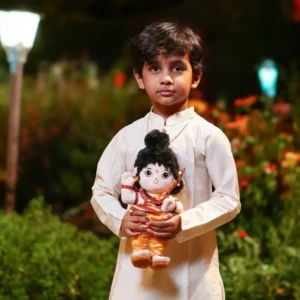
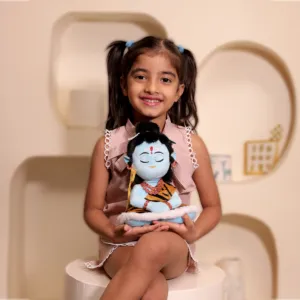
Our mantra chanting plush toys play gentle mantras when you press the tummy, a soft, familiar sound with cultural meaning instead of generic jingles. They are designed for ages 1–5 and certified to ASTM and EN-71 toy-safety standards. With a younger baby, enjoy them together and supervised: hold the plush, press it, sing along, and let your little one touch the soft fabric. Keep soft toys out of the sleep space for the first year.
Many families make one a part of the bedtime routine as their child turns one, or give one as a baby shower or first birthday gift. You might start with the small Baby Ganesha or small Baby Krishna, both about 23 cm.
Final thoughts
Musical toys work best when they support calm, shared moments: a gentle sound, a familiar song, a parent singing along. Babies do not need constant stimulation or complicated features. A soft melody, a little repetition and your full attention are what make musical play special in the first year.
Frequently asked questions
Are musical toys good for babies?
Gentle musical toys can be a lovely part of play and routines, especially when you play together. Choose soft sound, simple design and age-appropriate safety features, and keep sessions short and supervised.
What kind of musical toy suits an infant?
Something soft and simple: a gentle melody, easy controls, secure stitching, no small parts, and an age label that matches your baby.
Are sound toys safe for babies?
They can be, when the volume is soft, the battery compartment is secure, there are no detachable parts or flashing lights, and the toy is labelled for your child’s age.
How long should babies play with musical toys?
Short sessions of a few minutes, with quiet breaks in between, suit most babies. Watch your baby’s cues: if they look away or fuss, it is time for a rest.
When can I introduce musical toys?
Your own singing is perfect from day one. Gentle sound toys can be shared during supervised play as your baby grows; our mantra chanting plush are designed for ages 1–5.