Your Baby’s First Year: A Month-by-Month Play Guide
9 June 2025
A baby’s first year moves astonishingly fast. The newborn who cannot yet lift their head becomes, within twelve months, a little person who reaches, rolls, babbles, waves and, often, takes a few wobbly steps. Much of what happens along the way looks like simple play: looking at faces, listening to voices, grabbing, dropping and exploring.
Knowing roughly what babies tend to enjoy at each stage helps you choose toys they will actually use, skip the ones they are not ready for, and enjoy each phase instead of rushing to the next. One thing to keep in mind throughout: every baby is different. The ages below are loose ranges, not deadlines. If you ever have questions about how your baby is growing, your paediatrician or health visitor is the right person to ask.
The first year at a glance
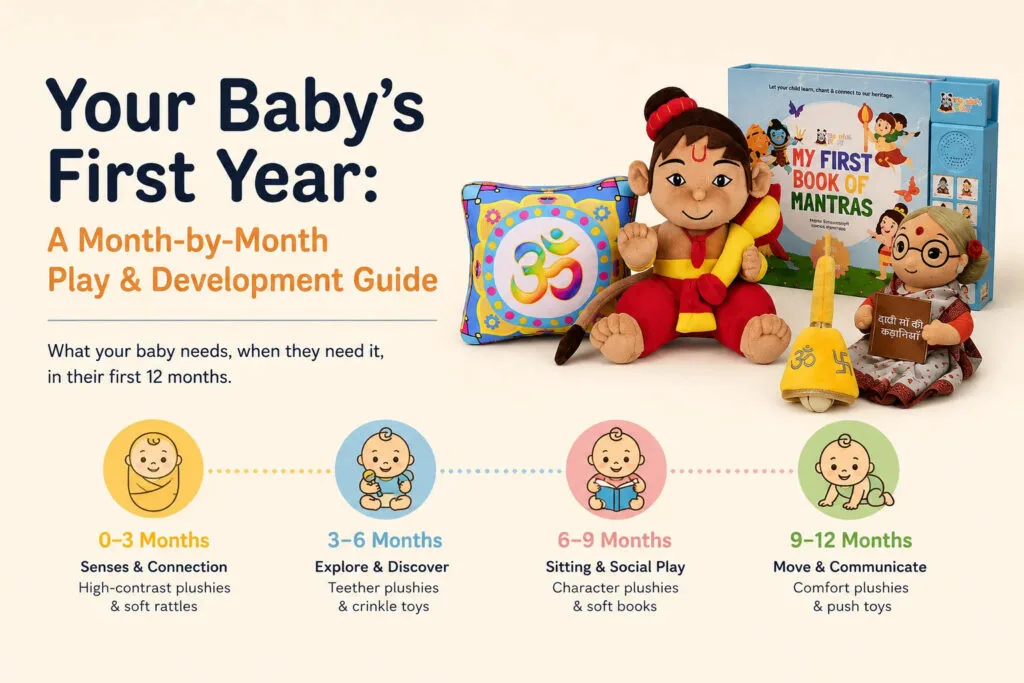
| Stage | What many babies enjoy | Simple play ideas | Toy types to consider |
|---|---|---|---|
| 0–3 months | Faces, voices, being held | Talking, singing, gentle touch | Simple high-contrast cards, a soft cloth to look at |
| 4–6 months | Reaching, grabbing, mouthing | Things that crinkle or rattle when touched | Teethers, crinkle cloth toys, soft rattles |
| 7–9 months | Sitting up, dropping things, peekaboo | Hide-and-find, soft books, press-and-play sounds | Cloth books, simple sound toys |
| 10–12 months | Crawling, cruising, pointing, waving | Rolling a ball, naming things, pretend care | Soft balls, push toys, a first comfort friend |
Months 0–3: the world arrives through the senses
What parents often notice
- Newborns gaze intently at faces held close to them.
- They often settle at the sound of a familiar voice.
- Bold black-and-white patterns tend to catch their eye.
- Over the first weeks, many babies begin to follow a moving face or object with their eyes.
Play ideas
- Talk, sing and make faces close to your baby. At this age, you are the favourite toy.
- Hum the lullabies or mantras you grew up with. Familiar family sounds are a lovely thing to share from the start.
- Offer short spells of tummy time on a soft mat while awake and supervised, following your health visitor’s advice.
- Keep sessions short: a few minutes at a time is plenty.
Months 4–6: hands discover the world
What parents often notice
- Babies discover their own hands and start reaching for things on purpose.
- Almost everything goes into the mouth. This is how babies explore.
- Laughter, squeals and big reactions arrive.
- Many babies begin rolling, and some sit with support towards the end of this stage.
Play ideas
- Offer safe teethers and toys that are easy to grasp and fine to chew.
- Crinkle cloth toys and soft rattles give an instant, satisfying response to a grab or a shake.
- During tummy time, place a colourful toy just out of reach to make the time more interesting.
Months 7–9: sitting, exploring and peekaboo
What parents often notice
- Sitting up frees the hands for more varied play.
- Peekaboo becomes hilarious, and babies start looking for a toy you have hidden under a cloth.
- Many babies show a clear preference for familiar people and may be wary of strangers or unhappy at separations.
- Passing things from hand to hand, banging and dropping things (again and again) are favourite games.
Play ideas
- Soft cloth books with different textures and flaps to lift.
- Simple press-and-play toys that make a gentle sound when touched.
- Hide-and-find games with a favourite toy under a muslin.
- If your baby starts to favour one particular toy, go with it. First attachments often appear around now.
Months 10–12: moving, babbling and belonging
What parents often notice
- Many babies crawl, pull themselves up and cruise along the furniture.
- Babbling grows more chatty, and some babies say a first word around the end of the first year or a little later.
- Pointing, waving bye-bye and understanding simple words like “no” or “come here” are common.
- Attachment to one special comfort object often grows stronger.
Play ideas
- Roll a soft ball back and forth; it is an early taking-turns game.
- Name things as you go: “Ganesha’s ears, Ganesha’s trunk, your nose!” Chatting through everyday moments is something babies love.
- Pretend play begins: feeding a teddy, rocking it to sleep, tucking it in.
- A sturdy push toy for babies who are pulling up and cruising.
The comfort object
Many babies between six and twelve months form a strong attachment to one particular soft toy or blanket. This is normal and very common, and many families find it helpful at nap times, on journeys and in new places. A practical tip that parents often wish they had heard sooner: if you can, buy a spare of the favourite, and rotate them so both smell and feel familiar.
For safe sleep, keep soft toys and loose bedding out of the cot for roughly the first year, and save cuddles for awake time. Your paediatrician or local safe-sleep guidance will have the details for your country.
Where Panda’s Box fits in
Our mantra chanting plush toys are designed for ages 1–5, so they come into their own as your baby turns one and beyond, just as many children are choosing a comfort friend. Before then, enjoy them together, supervised: press the tummy, listen to the mantras, and let your little one touch the soft fabric while you hold the toy.
- Our small plush (about 23 cm) are light enough for a toddler to carry everywhere.
- Our medium plush (about 28 cm) are just right for a proper hug.
- The Plush Evil Eye, with a gentle rattle, is designed for ages 0–3.
Every plush is certified to ASTM and EN-71 toy-safety standards.
Follow your baby, not the chart
Timelines are averages, not deadlines. One baby sits at five and a half months, another at seven and a half; both are perfectly normal. The most useful thing you can do is watch what your own baby is curious about and offer toys and games that match it. More than any toy, it is your time, your voice and your attention that your baby loves most.
For the next stage, see our baby toys by age guide (0–24 months).
Frequently asked questions
When can I introduce soft toys to my baby?
Soft toys made for young babies can be enjoyed during supervised, awake play. For sleep, keep the cot clear of soft items for roughly the first year, following safe-sleep guidance. Our plush toys are designed for ages 1–5.
What toys does a 3-month-old enjoy?
At around three months, babies are most interested in faces, voices and bold, simple patterns. Talking and singing to your baby, plus a soft rattle or a high-contrast card, is plenty.
My baby is very attached to one toy. Is that normal?
Yes, it is very common. Many children have a favourite comfort object, sometimes for years. Go with it, and consider buying a spare.
How many toys does a baby need in the first year?
Far fewer than you might think. A handful of simple, well-made toys, rotated now and then, tends to get far more use than a big collection.
What should I look for in a comfort toy?
Skin-friendly fabric, secure stitching with no small detachable parts, an age label that suits your child, recognised toy-safety certification, and a size that is easy to carry.
Do babies need “educational” toys in year one?
No. Babies mostly want you: your face, your voice and your company. Simple toys that respond to touch, plus lots of chatting, singing and cuddles, are all a first year needs.