Baby Toys by Age: A 0–24 Month Toy Guide
27 July 2025
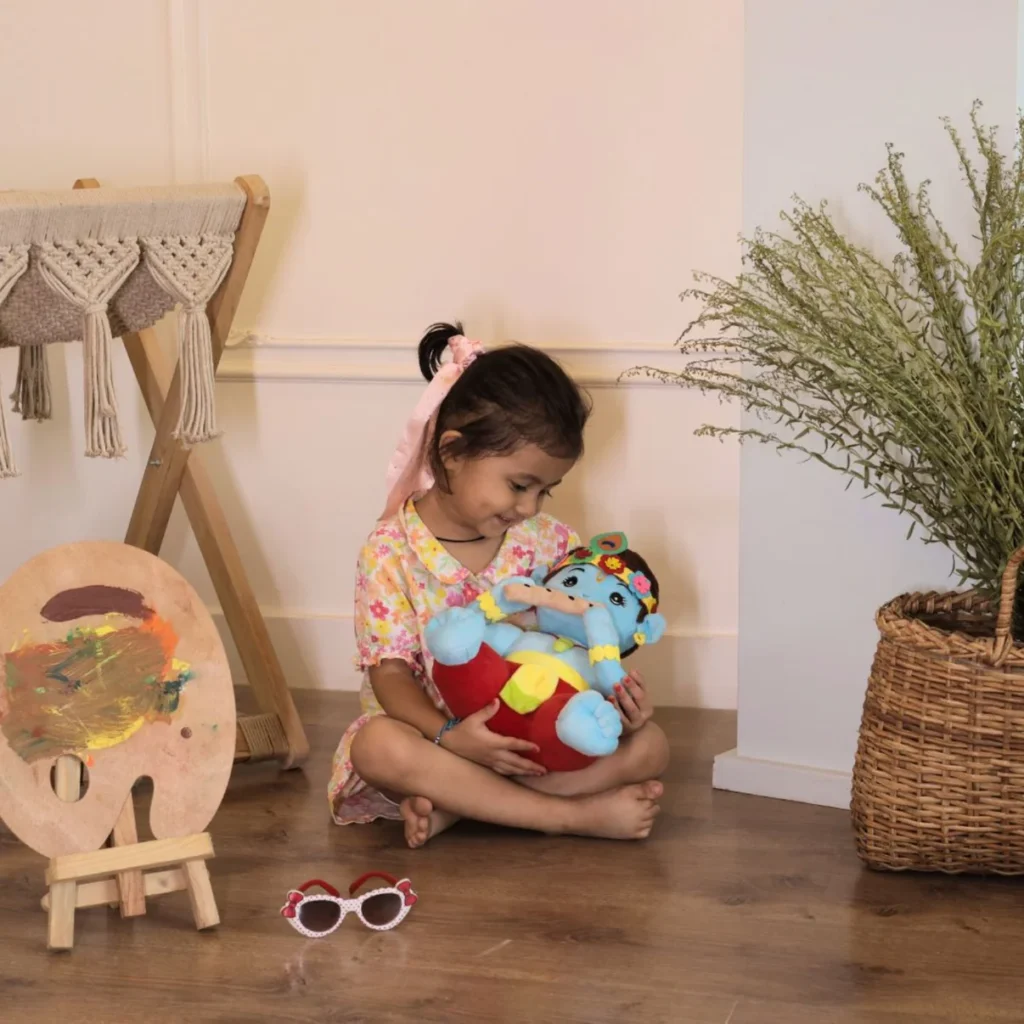
Walk into any toy shop and you will see the same labels on shelf after shelf: “0–2 years”, “18 months+”, “toddler”. They sound helpful until you realise they tell you very little about what your own baby will enjoy this month. A five-month-old who is just learning to reach is in a completely different place from a five-month-old who is already rolling and grabbing everything in sight.
This guide walks through baby toys by age, stage by stage, with what tends to work, what to skip, and why. Use it as a loose map. Every baby is different, and the best guide is always what your own child is curious about right now.
How to use this guide
Why the age on the box is not the whole story
Age labels on packaging are mainly about safety: a toy marked “6 months+” has passed small-parts testing for that age. Always respect those labels. But they do not tell you whether your baby will be interested in the toy yet, which is why two babies of the same age can enjoy very different things.
Watch your baby, not the calendar
Can your baby hold their head steady? Are they reaching on purpose? Have they started pulling themselves up? What your baby is doing is a far better clue to what they will enjoy than the number of months. Use the age bands below as a starting point, then follow your child’s lead.
0–3 months: faces, contrast and gentle sound
What newborns notice
Newborns see most clearly at close range, roughly the distance from your face to theirs during a feed. Bold, high-contrast patterns tend to hold their gaze more than pale pastels. They also tune in to familiar voices and soft, rhythmic sounds.
Toy types to consider
- High-contrast cards or soft books with bold patterns
- A soft rattle with a gentle, non-jarring sound
- Textured cloth toys that are easy to hold and safe to mouth
- A slow-moving mobile within close view (out of reach)
Honestly, the favourite “toy” at this stage is you: your face, your voice, the songs and lullabies you sing. Many families abroad like to hum the bhajans or mantras they grew up with, so those sounds feel familiar from the very beginning.
What to skip
Anything with small detachable parts, loud or sudden sounds, hard edges, or fiddly pieces your baby cannot use yet. A few simple things go a long way.
3–6 months: reach and grasp
What changes
During this stage, many babies move from a reflex grip to reaching for and holding things on purpose. You will see them swiping at toys, bringing them to their mouth and passing them from hand to hand. Toys that respond to what they do, a rattle that sounds when shaken or fabric that crinkles when squeezed, are especially satisfying.
Toy types to consider
- Lightweight rattles and easy-grip teethers
- Soft, squeezable toys with different textures
- A play gym with hanging toys just within reach
- Crinkly fabric toys
What to skip
Toys too heavy for small hands, anything with long cords or strings, and parts small enough to fit fully in your baby’s mouth. Since everything gets mouthed, choose toys made from safe materials with non-toxic dyes.
6–9 months: sitting up and “what happens if…”
What changes
Many babies can now sit with little or no support, so both hands are free to explore. Expect lots of dropping, banging, shaking and watching what happens next. It can look repetitive (and you will pick the same spoon up twenty times), but babies clearly love it. Toys still end up in mouths, so look for secure stitching and toys that are easy to keep clean.
Toy types to consider
- Stacking cups and simple press-a-button-hear-a-sound toys
- Soft blocks light enough to bang together
- Toys that make a noise when dropped or shaken
- Textured plush toys sized for two hands
9–12 months: pulling up and pointing
Peekaboo and hide-and-find
Around now, babies start to look for things that have been hidden, which is why peekaboo and hide-and-reveal games suddenly become so much fun. Pointing often appears too, a way of saying “look at that!” before the words arrive.
Toy types to consider
- Simple shape sorters with large pieces
- Nesting cups and stacking rings
- Pull-along toys for babies who are starting to cruise
- Soft toys with a pouch or flap to hide things in
Babies who are pulling up and cruising are testing their balance constantly, so keep play areas clear and choose sturdy toys that will not tip.
12–18 months: walking and copying
The comfort friend
Around the first birthday, many toddlers form a real attachment to one particular soft toy. A familiar plush can be a comfort at nap times, on journeys and in new places, so it is worth choosing that “special” toy thoughtfully, because it may stay around for years. Toddlers also start copying what they see: feeding a doll, “talking” on a toy phone, waving like a grown-up.
Toy types to consider
- A soft, durable comfort toy for daily cuddles and travel
- Push-and-pull walking toys
- Simple pretend-play toys: a play phone, a toy teapot, a soft doll
- Chunky knob puzzles
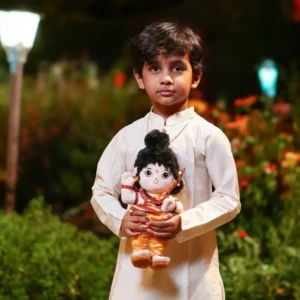
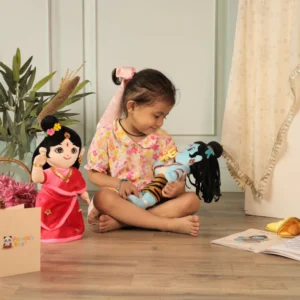
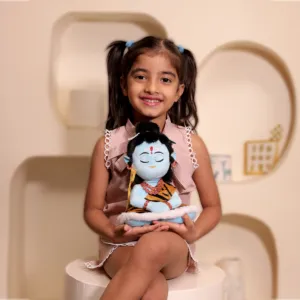
This is where our mantra chanting plush toys come in. They are designed for ages 1–5, certified to ASTM and EN-71, and play gentle mantras when you press the tummy. Our small plush (about 23 cm) are easy for a new walker to carry around.
18–24 months: pretend play and lots of chatter
Naming, sorting and singing along
Many toddlers are chatting more and more in this window, and they love games built on naming (“Where’s the cow?”), sorting by colour or shape, and simple songs with repeated lines. Pretend play gets richer too: putting teddy to sleep, stirring an imaginary pot, lining toys up in a careful row.
Toy types to consider
- Sorting and matching toys with familiar animals or objects
- Soft toys linked to stories, songs or simple chants
- Early pretend-play sets: kitchen, doctor’s kit, doll care
- Board books to read and re-read
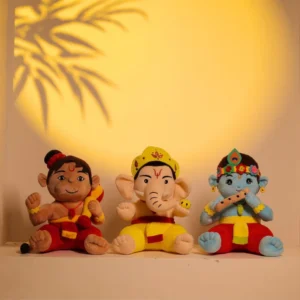
A plush Ganesha or Krishna that chants the same mantras every time fits naturally here. Toddlers love repetition, and singing along together becomes a sweet shared ritual, especially when grandparents are far away. My First Book of Mantras, a press-to-play sound book, is another favourite for this stage.
How many toys does a baby actually need?
Rotation beats a big toy basket
Many family homes, especially flats and apartments, do not have a playroom, and babies do not need one. An overflowing toy basket can be more overwhelming than fun. Rotation solves both the space and the boredom problem: keep most toys stored away and swap a small set every week or two. Toys that have been “away” for a while come back feeling brand new.
A simple six-toy approach
One approach many families like is to keep around six toys out at a time, each a different kind of play: one for movement, one for sound, one for pretend play, one for building or sorting, one comfort toy and one current favourite. Everything else waits in rotation storage. A mantra chanting plush can happily fill the comfort or sound slot.
Safety checks at every age
- Size: any toy or part should be too large to fit through a toilet-paper roll, a quick, widely used choking-hazard check.
- Seams: stitching should be tight and strong, especially on plush that gets chewed, pulled and washed.
- Sound: keep volume gentle and avoid toys that are loud or startling.
- Supervision: even the safest toy needs a grown-up nearby, especially in the mouthing stage.
- Sleep: keep soft toys out of a baby’s sleep space for roughly the first year.
- Certification: look for recognised toy-safety standards such as ASTM (USA) or EN-71 (Europe and UK).
For more detail, read our guides on choosing safe soft toys and which plush size suits each age.
Frequently asked questions
What toys does a newborn actually need?
Very few. A high-contrast soft book, a gentle rattle and one textured cloth toy are plenty, along with lots of talking, singing and cuddles.
How many toys should a 1-year-old have?
About five or six out at a time, covering movement, sound, pretend play and comfort, is enough for most families. Store the rest and swap every couple of weeks.
What toys do 6-month-olds enjoy?
Toys for sitting and two-handed play: stacking cups, textured soft toys, and simple toys that make a sound when banged or dropped. Peekaboo games are a hit too.
Are soft toys suitable for babies under 6 months?
Soft toys designed for young infants can be enjoyed during supervised, awake play, provided they are lightweight, securely stitched, free of small parts and easy to clean. Keep them out of the sleep space. Our plush toys are designed for ages 1–5.
When can I introduce musical toys?
Gentle sounds, lullabies and soft chimes can be shared from the early months, with you nearby. Keep the volume low and choose calm sounds over busy, flashing electronics.
What toys are good for chatting and singing together?
Anything that invites naming, repetition and call-and-response: sorting toys you name aloud, songs with repeated lines, board books and soft toys linked to chants or rhymes. The magic is in doing it together.