Small Soft Toys vs Large Plush: Which Size Works Best at Each Age
27 July 2025

Scroll through any toy listing and you’ll see a detail most parents skim past: the size, written in centimetres somewhere below the photo. It looks like a minor spec, but size often decides whether a soft toy gets loved every day or ends up in a cupboard because it was too big for tiny hands or too small to cuddle at bedtime.
This guide walks through which size tends to suit each age, so choosing a soft toy is less guesswork.
Why size matters more than you’d expect
Can they actually hold it?
A young baby’s hand can barely close around anything wider than a finger, while a two-year-old can happily carry a toy nearly half their own height. A toy that is too big for a baby’s grip just sits there. Before buying, picture your child’s hands, not just how cute the product photo looks.
Safe sleep comes first
Standard safe-sleep advice is to keep soft toys, pillows and loose bedding out of a baby’s sleep space for the first year. Large, pillow-like plush toys are best kept out of the cot entirely until your child is older.
A simple size guide by age
| Age | Suggested size | Why |
|---|---|---|
| 0–6 months | 15–20 cm | Easy to hold during supervised play |
| 6–12 months | 20–25 cm | Suits two-handed holding and exploring |
| 1–2 years | 25–35 cm | Big enough to hug, light enough to carry |
| 2 years and up | Any size | Mostly a matter of preference |
0–6 months: 15–20 cm
At this stage a toy needs to be small enough to bat at or hold during supervised tummy time. Anything bigger simply isn’t usable yet.
6–12 months: 20–25 cm
Once babies sit up and start reaching with intent, a slightly bigger toy is easier to hold with both hands and more fun to explore. Always check the age range on the label: our plush toys are designed for ages 1–5, so under-ones should play with them together with a grown-up.
1–2 years: 25–35 cm
Toddlers are strong enough to carry a properly huggable toy around the house, and many form a real attachment to one particular plush at this age. Our small plush (about 23 cm) and medium plush (about 28 cm) sit right in this range.
2 years and up
From here, size is mostly about preference and space. Larger, more elaborate plush toys that sit proudly on a bed or shelf start to make sense.
When small wins
Prams, car seats and flights
A small toy fits into a diaper bag, a car-seat pocket or a seat-back pocket on a long-haul flight without adding bulk. For families who travel often, including those long trips to see grandparents, compact is simply more practical. Our small plush toys have a hanging loop for the pram or car seat.
Return gifts and group gifting
Small plush toys are a popular choice for birthday return gifts, naming ceremonies and baby showers, where you want a thoughtful gift for several children rather than one big centrepiece. See our ideas for birthday return gifts.
Building a collection
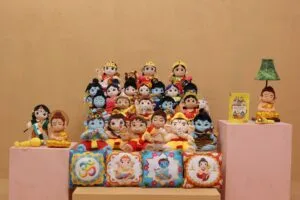
Smaller toys work well when the fun is in the set: a shelf of characters your toddler can line up, sort and name. Packs such as our small Krishna, Ganesha and Hanuman set make that easy.
When large wins
A special comfort toy
If your toddler is forming a bond with one special toy, a bigger size often works better for comfort: something substantial to hug tightly at nap time or in a new place.
Nursery styling and photos
A larger plush can become part of the nursery, sitting on a shelf or in a reading corner. Many parents also use one in monthly milestone photos: the toy stays the same size while the baby grows.
Milestone gifts
For a first birthday, a naming ceremony or a welcome-home gift, a larger plush feels like a lasting keepsake rather than an everyday on-the-go toy.
How to read size on a listing
Seated height vs full height
Brands measure plush toys differently. Some give seated height (the toy propped upright), others the full length. A 25 cm “seated” toy can look noticeably smaller than a 25 cm “standing” one, so check which is meant.
Why photos mislead
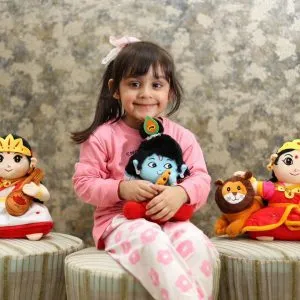
Close-up product photos and props can make a toy look bigger or smaller than it is. Compare the listed size with something at home: a standard water bottle is roughly 20–22 cm tall.
Frequently asked questions
What size soft toy suits a young baby?
Something small, around 15–20 cm, for supervised play. Keep all soft toys out of the cot for babies under one.
Are large soft toys safe in a cot?
Not for babies under 12 months. Large or pillow-like toys are better as nursery décor or for supervised cuddles until your baby is older.
What size is best for travel?
Around 20–25 cm fits easily into a diaper bag or seat pocket. Our small plush toys, about 23 cm with a hanging loop, are made with this in mind.
What sizes does Panda’s Box make?
Our small plush toys are about 23 cm and our medium ones about 28 cm (a few medium deities are 26–30 cm; the exact size is in each product title). Browse all our plush toys.