Interesting Facts About Indian Mythology
14 October 2022
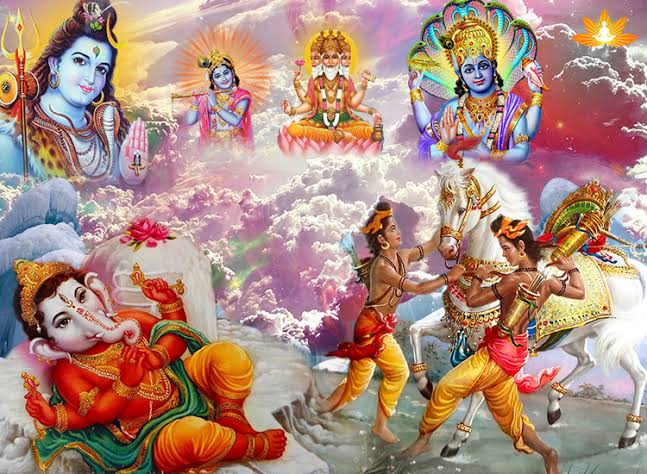
Indian mythology is one of the richest storytelling traditions in the world. Hinduism is among the oldest living religious traditions, with roots stretching back thousands of years, and its stories have been told and retold, around fires, in temples and at bedtime, by generation after generation.
Whether you grew up with these stories or are discovering them alongside your children abroad, here are some fascinating facts to share.
1. There are many stories of how the universe began
Hindu texts offer several accounts of creation rather than a single one. One of the best known describes a time before time: no heaven, no earth, no space, only a dark, endless ocean. From this stillness, creation unfolds. In another well-loved image, Vishnu rests on the great serpent Shesha upon the cosmic ocean, and Brahma, the creator, appears on a lotus that grows from Vishnu’s navel.
2. A trinity at the heart of it
Many traditions speak of the Trimurti, three great forms of the divine: Brahma the creator, Vishnu the preserver and Shiva the transformer. Each has a partner goddess: Saraswati, goddess of knowledge and the arts; Lakshmi, goddess of prosperity; and Parvati, who also appears as the fierce Durga and Kali.
3. “330 million gods”
You may have heard that Hinduism has 33 crore (330 million) gods. The number comes from a reading of the word “koti” in old texts, which can mean either “crore” or “type”. Many scholars read it as 33 types of deities. Either way, the idea behind it is lovely to share with children: the divine can be seen in many forms, and each deity represents a quality of life, such as Ganesha for new beginnings or Saraswati for learning.
4. Time moves in great cycles
Hindu cosmology sees time as a wheel rather than a straight line. A Maha Yuga is made up of four ages, or yugas, that repeat again and again:
- Satya Yuga, the age of truth, traditionally said to last 1,728,000 years, when people lived in harmony and goodness.
- Treta Yuga, 1,296,000 years, when goodness begins to fade a little. Rama’s story is set in this age.
- Dwapara Yuga, 864,000 years, when good and bad are evenly matched. Krishna and the Mahabharata belong here.
- Kali Yuga, the shortest at 432,000 years, an age of restlessness and confusion. According to tradition, we are living in it now.
When one cycle ends, another begins. Children often find this idea of endless renewal surprisingly comforting.
5. Two great epics
The Ramayana tells of Prince Rama, his exile, the rescue of Sita and his return home, which many families celebrate at Diwali. The Mahabharata, one of the longest poems ever composed, tells of the Pandava and Kaurava cousins and contains the Bhagavad Gita, Krishna’s guidance to Arjuna on the battlefield.
6. The Vedas came first
The Vedas are among the oldest sacred texts in the world. They are collections of hymns composed in Sanskrit in the north-west of the Indian subcontinent, with the earliest, the Rig Veda, usually dated by historians to around 1500–1000 BCE. For centuries they were passed on orally, memorised word for word, long before they were written down.
7. Many universes
Traditional Hindu cosmology speaks of countless universes, each arising and dissolving in cycles, and of vast spans of time: a single day of Brahma is said to last thousands of Maha Yugas. It is a wonderful way to spark a child’s sense of wonder about the size of the cosmos.
Sharing these stories with children
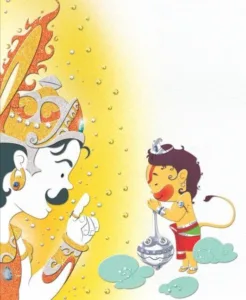
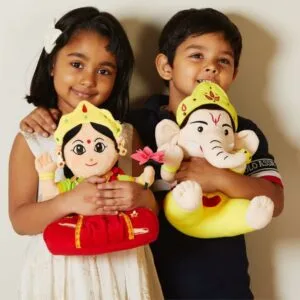
These stories are full of courage, kindness, humility and hope, and children can enjoy them long before they understand the philosophy. Start with the characters they can picture: the elephant-headed Ganesha, the mischievous butter thief Krishna, the brave monkey Hanuman. Tell one story at bedtime, draw the characters together, or let a soft toy play the hero.
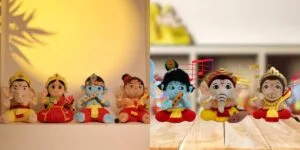
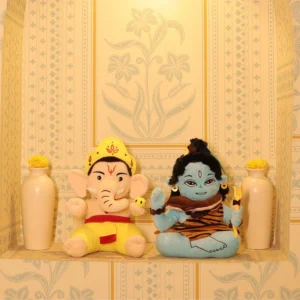
Our mantra chanting plush deities give little ones a friendly face to go with each story. Read more in How to introduce Hindu gods to kids and the 10 avatars of Vishnu Ji.