How to Introduce Hindu Gods to Kids: A Simple, Fun Guide
2 February 2026
Sooner or later, every child in a Hindu family asks the question: who are all these gods? For families raising children outside India, the question often comes earlier and more often, prompted by a school friend, a festival assembly or the little mandir in the corner of the living room. Here is a simple, gentle way to answer it.
What are Hindu gods? A simple explanation for kids
Hindu gods are divine forms that represent different qualities and powers in the universe. Rather than seeing them as completely separate beings, many families explain them as different expressions of one divine energy. Each one has a role, but they are all connected.
For children, it helps to keep it simple:
- Some gods protect the world
- Some teach us important lessons about life
- Some show us how to be brave, kind or truthful
Each god has stories, a personality and a purpose. The stories are not only about miracles; they are about values like honesty, courage, love and devotion. With young children, focus less on complexity and more on the meaning behind each story.
The idea of one supreme divine power
A common question is whether there is one god or many. Hindu philosophy teaches that there is one ultimate reality, often called Brahman, and that the many gods are different forms or aspects of it.
For kids, try this example. Sunlight comes from one sun, but we see it in many ways: soft morning light, golden evening light, a rainbow, a reflection on water. In the same way, the different gods are different forms of the same divine source.
This helps children understand that:
- There is unity behind all the variety
- The gods are not rivals or competing with one another
- All forms are connected to one higher power
A few Hindu gods to introduce first
There are many deities in Hinduism, but a handful have stories that young children relate to easily. These make a good starting point.
Ganesha: the remover of obstacles
Ganesha is worshipped before every new beginning, from a puja to a new school year. With his elephant head, his sweet tooth for modaks and his little mouse companion, he is often the first god a child gets to know. Children can learn from Ganesha that every new start deserves a moment of thought and a prayer, and that obstacles can be overcome with patience and wisdom.
Shiva: calm, strength and change
Shiva is often shown deep in meditation, calm and focused. Children can learn from Shiva that:
- Staying calm is a kind of strength
- Change is a natural part of life
- Inner peace matters
Durga: strength and protection
Goddess Durga, riding her lion and defeating the buffalo demon Mahishasura, represents courage and protection. Her stories, especially at Navratri, help children understand that:
- Being brave helps us face challenges
- Good wins over evil in the end
- Inner strength is important
Krishna: the playful god
Children love Krishna for his playfulness. From stealing butter as a little boy in Gokul to guiding Arjuna in the Bhagavad Gita, his stories are full of lessons. Kids enjoy learning that:
- It’s okay to be playful and curious
- Wisdom can come from simple moments
- Love and kindness matter most
Rama: the ideal king
Rama represents honesty, duty and doing the right thing. His story in the Ramayana shows:
- The importance of keeping promises
- Respect for family and relationships
- Standing up for what is right, even when it is hard
Hanuman: strength and devotion
Hanuman is admired for his strength, courage and loyalty. Children connect with him easily because:
- He is brave and fearless
- He helps others without expecting anything back
- He shows loyalty and faith
Fun ways to teach kids about Hindu gods
Learning works best when it is interactive and enjoyable, and when it happens a little at a time.
- Storytelling sessions. Share a short story from the Ramayana or the Mahabharata at bedtime.
- Picture books. Bright illustrations make the characters easier to follow and remember.
- Temple visits. Even an occasional visit to your local mandir helps children see traditions in real life.
- Festival celebrations. Celebrating Janmashtami, Ganesh Chaturthi or Diwali at home, even in a small way, gives the stories context.
- Small daily rituals. Lighting a diya or saying a short prayer builds familiarity.
- Calls with grandparents. Ask them to tell the story of the next festival over a video call. Children love hearing how it was celebrated “back home”.
Consistency matters more than length. Small, regular moments work better than long explanations.
Teaching through stories
Stories hold children’s attention in a way that explanations rarely do. Rather than focusing only on what happened, highlight what the story means:
- Krishna sharing butter with his friends shows joy and generosity
- Hanuman leaping across the ocean shows courage
- Rama’s long journey shows patience and responsibility
When telling stories, use simple language, add expressions and voices, and ask questions to involve your child: “What would you have done?” Over time these stories become shared family memories.
Creative activities
- Colouring pages of the gods and their stories
- Role play, with your child as Rama, Krishna or Hanuman
- Simple crafts, such as a paper flute for Krishna or a cardboard gada for Hanuman
- Singing bhajans or listening to devotional songs together
- Drawing a scene from a favourite story
- Jigsaw puzzles of the deities, such as our Divine Favourites puzzle
Mistakes to avoid
- Giving too many details at once
- Using fear-based explanations
- Pushing children to memorise instead of understand
- Brushing off their questions
- Comparing gods in a way that creates confusion
Let learning happen naturally, and let your child’s curiosity lead.
Bringing the stories into everyday play
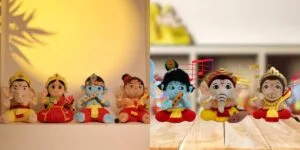
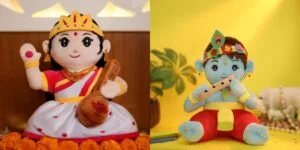
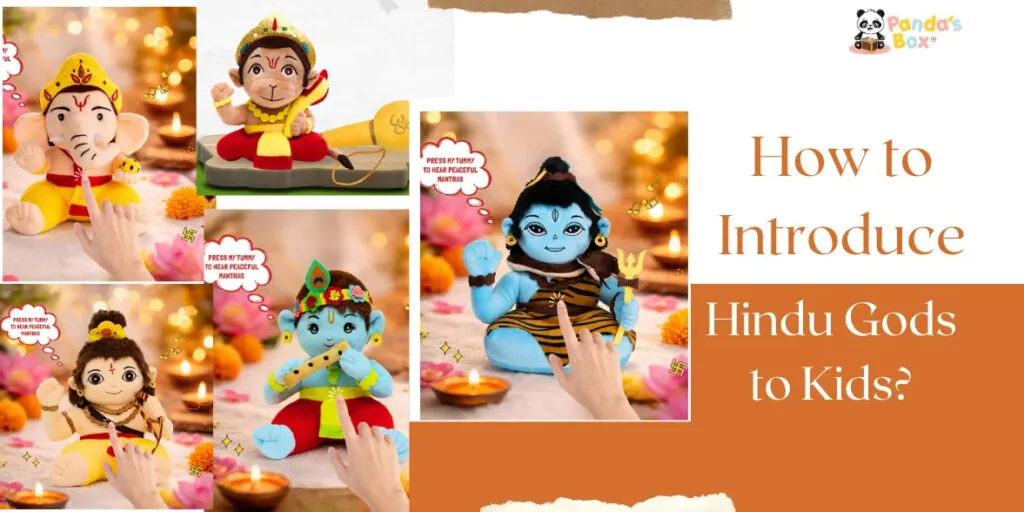
Stories and rituals are the heart of it, but familiar objects help the stories stay close. After hearing about Krishna or Hanuman, a child can press the tummy of a soft mantra chanting plush and hear that deity’s mantras, so the sounds of the stories become a comforting part of the day. Sound books, puzzles and storyteller toys can carry on what you started at bedtime, especially on the days when grandparents are far away.
Conclusion
Introducing Hindu gods to children is not about teaching everything at once. Start with one story, one lesson or one small ritual. When children understand the values behind the stories, they begin to notice them in real life, and that is the beginning of a lifelong connection with their culture, wherever in the world they are growing up.
Frequently asked questions
Who are the main Hindu gods?
Some of the best-known are Ganesha, Shiva, Vishnu, Krishna, Rama, Hanuman, Durga, Lakshmi and Saraswati. Their stories are a good place for children to begin.
How do I explain Hindu gods to a young child?
Start with simple stories and focus on values, such as bravery, kindness and honesty, rather than complex beliefs. Picture books and play help a lot.
Who is the supreme god in Hinduism?
Hindu philosophy speaks of one supreme divine reality, often called Brahman. The many gods are understood as forms of that one divine power.
What are easy stories of Hindu gods for kids?
Krishna stealing butter, Hanuman leaping across the ocean, Ganesha’s race around the world and Rama’s journey in the Ramayana are all simple and engaging.
Which god should children learn about first?
Many families start with Ganesha, Krishna or Hanuman, because their stories are fun and easy to relate to. Browse our Ganesha, Krishna and Hanuman plush, or read more on teaching kids about Indian gods and heroes.