Why Screen-Free Familiarity Matters More Than Early Learning Apps
23 February 2026
Screens reach every part of family life now, and they reach younger children than ever. Early learning apps promise a head start, and on a tired evening they can feel like a lifesaver. But many parents have a nagging sense that something is missing. This post looks at why everyday, screen-free familiarity deserves a bigger place in a young child’s day.
Handing a toddler a tablet to calm a meltdown or to get through dinner has become a normal part of modern parenting. When parents are stretched thin, an app with bright, “educational” content that holds a child’s attention can feel like a win.
Yet watching content is not the same as understanding it. Convenience, however tempting, can hide what young children need most in their earliest years: not more stimulation, but familiarity.
The promise of “educational” screens
Apps are good at surface results. A toddler may name colours, match shapes or sing the alphabet. Underneath those skills sit slower things: patience, coping with frustration, and curiosity that grows out of real experience.
Most apps work in two dimensions, while young children live in three. A child learns that a block is heavy by lifting it, not by dragging a picture of one across a screen. Balance comes from running and riding a tricycle, not from a game about bikes.
Real objects, real hands
Many parents notice that a child who can finish a puzzle on a tablet still finds a real jigsaw tricky. Turning pieces, feeling where they fit and trying again is something that happens in the hands and eyes, through trial and error. A screen can show an idea, but it cannot replace doing it.
What familiarity really teaches
This is where familiarity quietly does its work: the same faces, the same voices, the same songs at the same time of day. Children learn how to handle feelings by watching how the adults around them respond to stress, joy, sadness and disappointment.
A parent’s face reflects a child’s feelings back to them and helps those feelings make sense. A cartoon character might hold a child’s attention for a while, but the habits that last are the ones they pick up from the people who care for them.
Predictability over constant excitement
Apps are built for instant reward: bright colours, cheerful sounds, a prize every few seconds. Real life moves more slowly. Sometimes it is quiet, repetitive, even boring, and that slower pace is where patience and an inner sense of motivation can grow.
The value of a little boredom
Boredom is often feared, but it is a wonderful space. When nobody is entertaining a child, imagination steps in. A cardboard box becomes a spaceship, a stick becomes a magic wand. Creativity often comes not from instruction but from empty time, and screen-free moments create that time. There is emotional value too: when a screen always arrives to distract, children get fewer chances to sit with a difficult feeling and come through it.
Learning through the senses
Crawling, climbing and touching different textures are rich, physical experiences. Following a ball as it rolls across the room is very different from watching one on a flat screen. Real-world play gives children something a glass screen simply cannot.
Building screen-free familiarity at home
None of this means rejecting technology altogether. It means making room for simple, familiar moments:
- Narrate the day. Talking through bath time, cooking or the walk to the park turns ordinary routines into rich conversation.
- Cook together. Textures, smells and the order of steps are a whole lesson in themselves.
- Keep crayons and paper within reach. Free drawing invites ideas that no pre-set app can.
- Choose real puzzles and toys. They have weight, resistance and consequences, like our festival and deity jigsaws.
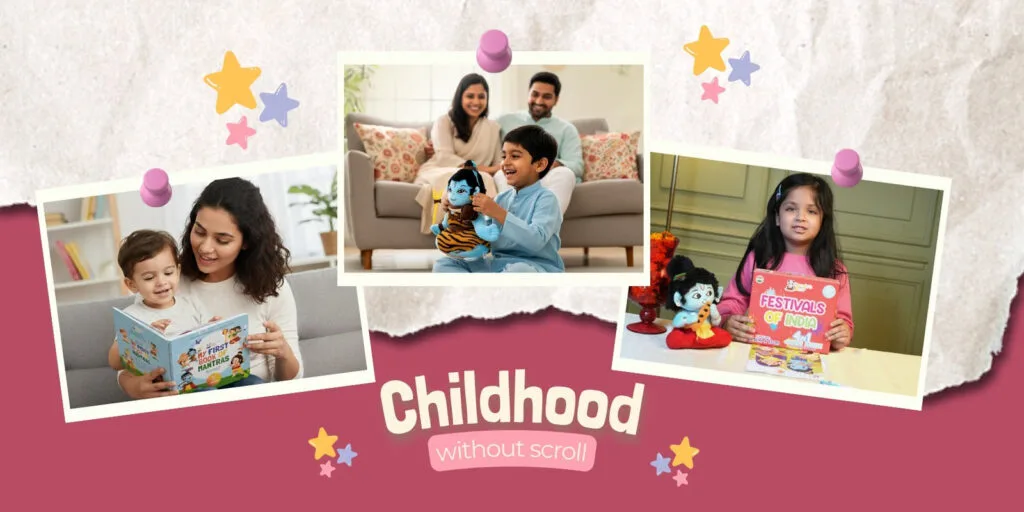
- Repeat the same songs and prayers. A bedtime chant or a mantra played by a plush toy becomes a calming, familiar cue that the day is ending.
When screens are used, intention matters. Watching together, talking about what you see and asking questions turns passive viewing into a shared experience. The screen becomes a tool, not a substitute.
The learning that lasts
Early childhood is not a race. Children do not fall behind because they did not swipe soon enough. What shapes them most is not exposure to information but the relationships around them: the familiar rhythm of a parent’s voice and the comfort of a predictable routine. If you are looking for screen-free companions for that routine, try My First Book of Mantras or our Storyteller Grandma and Dadima.