The 9 Forms of Durga in Navratri: A Day-by-Day Guide for Families
7 December 2025
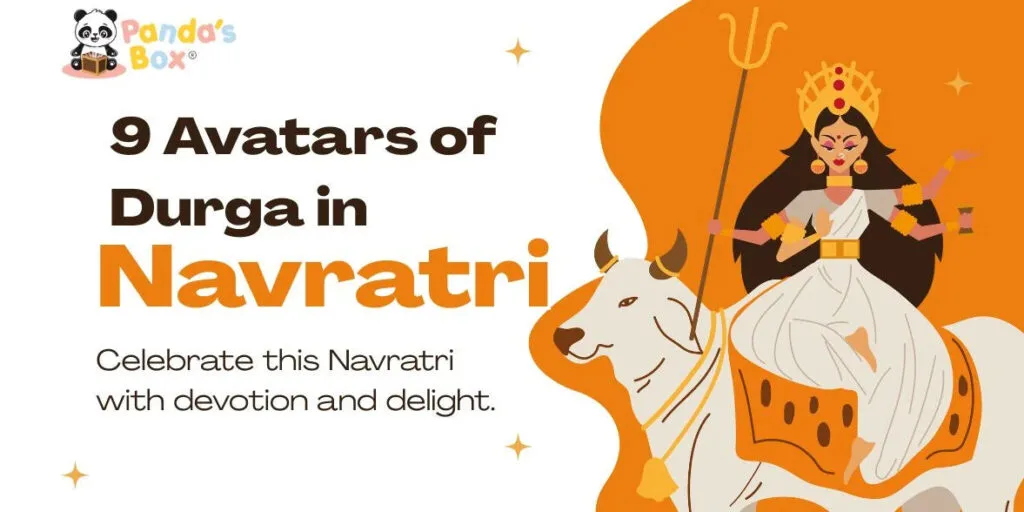
Navratri, the festival of nine nights, celebrates the nine forms of Goddess Durga, known together as the Navadurga. Each day is dedicated to one form of the Devi, and each one carries a value worth sharing with children: strength, patience, courage, love and wisdom.
Whether you are celebrating in a temple hall in New Jersey, at a garba night in London or simply around your own home altar, this day-by-day guide makes the nine forms easy to understand and easy to explain to little ones.
The nine forms of Durga at a glance
| Day | Form of Durga | What she stands for |
|---|---|---|
| Day 1 | Maa Shailputri | Strength and fresh starts |
| Day 2 | Maa Brahmacharini | Devotion and patience |
| Day 3 | Maa Chandraghanta | Courage |
| Day 4 | Maa Kushmanda | Energy and joy |
| Day 5 | Maa Skandamata | A mother’s love |
| Day 6 | Maa Katyayani | Power to face problems |
| Day 7 | Maa Kalaratri | Protection |
| Day 8 | Maa Mahagauri | Peace and purity |
| Day 9 | Maa Siddhidatri | Wisdom |
Read in order, the nine forms trace a journey from strength to wisdom.
The Navadurga, day by day
Day 1: Maa Shailputri
Shailputri, “daughter of the mountains”, is the first form of the Navadurga. She stands for strength, stability and a fresh start.
A simple way to honour her: clean the prayer space, light a diya and offer a little ghee.
Day 2: Maa Brahmacharini
Brahmacharini stands for devotion and patience. She reminds us to stay calm and keep going.
A simple way to honour her: offer sugar or fruit and sit quietly together for a minute or two.
Day 3: Maa Chandraghanta
Chandraghanta wears a half-moon shaped like a bell on her forehead. She gives courage and chases away fear.
A simple way to honour her: offer milk or a sweet, and let your child ring the bell during the aarti.
Day 4: Maa Kushmanda
Kushmanda is said to have created the universe with her smile. She brings energy, happiness and light.
A simple way to honour her: offer a sweet such as malpua and light a diya.
Day 5: Maa Skandamata
Skandamata, the mother of Skanda (Kartikeya), is usually shown holding her baby son. She represents love, care and motherhood, which makes her a lovely form to talk about with children.
A simple way to honour her: offer bananas and say a prayer for the whole family’s happiness.
Day 6: Maa Katyayani
Katyayani is the warrior form who defeated the buffalo demon Mahishasura. She stands for courage and the power to overcome problems.
A simple way to honour her: offer honey and pray for strength.
Day 7: Maa Kalaratri
Kalaratri is the fiercest form of Durga. She removes darkness and negativity and protects her devotees. With small children, you can describe her simply as the Devi who chases away the dark.
A simple way to honour her: offer jaggery and light a diya.
Day 8: Maa Mahagauri
Mahagauri stands for peace, purity and calm. Many families perform Kanya Puja on the eighth or ninth day, honouring young girls as forms of the Devi.
A simple way to honour her: offer coconut and keep the home peaceful and bright.
Day 9: Maa Siddhidatri
Siddhidatri, the last of the Navadurga, gives wisdom and spiritual growth.
A simple way to honour her: offer sesame seeds or halwa and pray for knowledge.
When is Navratri?
Navratri follows the Hindu lunar calendar, so its dates move every year. There are two main Navratris:
- Chaitra Navratri usually falls in March or April and ends with Ram Navami.
- Sharad Navratri usually falls in late September or October and is followed by Dussehra (Vijayadashami). It is the most widely celebrated of the two.
Your local temple or community calendar will have the exact dates for your time zone each year.
Navratri colours
Many families wear a different colour on each of the nine days. The colour list changes from year to year because it follows the weekday each day falls on, so check the current year’s list. Children usually love choosing their outfit for the day.
Why the nine forms matter
Each form of Durga stands for a quality we all need: courage, patience, love, wisdom. Talking about one form each day gives children a small, memorable lesson, and gives the whole family a reason to pause, light a lamp and spend a few minutes together.
Simple Navratri ideas for families and kids
- Learn one Navadurga name each day and make a little paper chart to tick off.
- Tell a short story about that day’s form at bedtime.
- Chant a short Durga mantra together.
- Follow the colour of the day.
- Go to a garba or dandiya night. Many cities abroad have family-friendly evenings.
- Pick one small act of kindness or gratitude for each day.
Celebrate Navratri with a Devi Durga plush
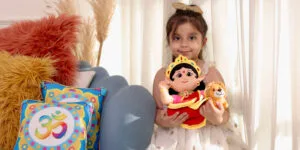
Our Devi Durga plush (medium, about 26 cm) and the small Devi Durga chant Durga mantras when you press the tummy. Children can hold her during the evening aarti, and she makes the nine-night story easy to tell. Designed for ages 1–5 and certified to ASTM and EN-71 toy-safety standards.
Want more on the festival? Read Navratri: the nine nights of celebration and devotion and why Maa Durga looks different during Navratri and Durga Puja.
Frequently asked questions
What are the nine forms of Durga?
Shailputri, Brahmacharini, Chandraghanta, Kushmanda, Skandamata, Katyayani, Kalaratri, Mahagauri and Siddhidatri, worshipped one per day across the nine nights of Navratri.
What does “Navadurga” mean?
“Nava” means nine, so Navadurga simply means the nine forms of Durga.
When does Navratri begin?
It follows the lunar calendar. Chaitra Navratri usually falls in March or April, and Sharad Navratri in late September or October. Check your local temple calendar for this year’s dates.
Wishing your family a joyful Navratri. Explore our divine plushies for more festival friends.