How to Remove Nazar From Kids: 7 Gentle Family Traditions
26 May 2026
If you have ever heard a grandmother say “Nazar lag gayi hai” after a little one suddenly turned cranky at a party, you are not alone. Across Indian homes, and in Indian homes all over the world, small rituals to “take off the nazar” have been passed down for generations as loving acts of care.
These traditions are less about fear and more about family: a grandparent’s hands, a few familiar words, a moment of attention just for the child. Here is a gentle look at what nazar means, the rituals many families keep, and how to share them with children without making anything scary.
What does “nazar” mean?
Nazar, often translated as the “evil eye”, is the traditional belief that too much attention, praise or envy can affect a person, especially a small child. Children are seen as especially precious, which is why so many nazar customs centre on babies and toddlers.
There is no scientific evidence for nazar, and these customs are not a remedy for anything. Families keep them because they are part of who they are: rituals that bring a sense of comfort, continuity and closeness. For many homes, “removing nazar” is simply another way of saying “we love you and we are looking after you”.
A gentle reminder: if your child seems unwell, unusually upset, isn’t feeding or isn’t sleeping, talk to your doctor or health visitor first. Cultural rituals are for comfort and connection, never a replacement for medical care.
7 nazar traditions Indian families keep
1. Salt and mustard seeds
One of the most familiar customs uses a pinch of rock salt, a few mustard seeds and sometimes dried red chillies. An elder circles them around the child’s head, often seven times, and then throws them away outside the house. In some homes they are dropped into a fire; if yours does, keep children well back from any flame and smoke.
2. A tiny kajal dot
Many parents and grandparents place a small black dot behind the ear, on the sole of the foot or near the chin. The idea is to “break perfection”, so that no one’s admiring look lingers too long. If you follow this custom, use a tiny dot of a product made for skin, and keep it away from the eyes.
3. Lemon and chillies at the door
A lemon threaded with green chillies hung by the front door is a common sight in Indian neighbourhoods. It symbolises keeping unwanted energy outside the home. Many families abroad keep a small version by the door as a reminder of home.
4. Hanuman prayers
Lord Hanuman is loved as a protector, and many families recite the Hanuman Chalisa or a short Hanuman mantra with their children. Little ones often enjoy the steady rhythm of the chant and the sound of familiar voices.
5. Coconut at the temple
In some traditions, a coconut is circled around the child and then broken at a temple, symbolising leaving any heaviness behind.
6. The evil eye charm
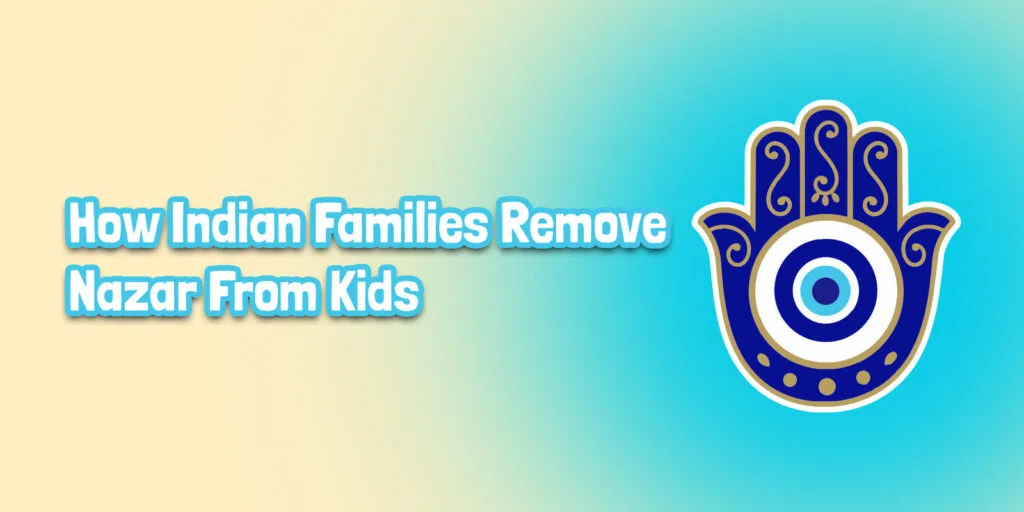
The blue-and-white evil eye charm (nazar battu) is popular across India and far beyond, from Turkey and Greece to the Middle East. Families hang one near the cot or pin it to a stroller as a keepsake.
7. Simply holding the child close
The oldest custom may also be the simplest: holding your child, singing softly, telling a bedtime story, a gentle hand on the back. After a busy day of visitors and noise, many little ones just need quiet, closeness and routine. Our grandmothers understood this long before modern parenting language existed.
Why these rituals feel comforting
Rituals help children feel safe, seen and connected to their family’s ways. For parents, they create a small pause in a busy day. And for families living far from grandparents, carrying out a nazar ritual the way Nani did can feel like a phone call across the ocean.
How to talk to children about nazar without fear
Children should never grow up afraid of “bad eyes” or “bad energy”. Keep it gentle and positive. You might say:
“When you’ve had a big, busy day, our family does a little ritual to show how much we love you.”
Keep the focus on love, care, comfort and family tradition, not on anything to be scared of.
A simple bedtime ritual inspired by tradition
- Wash hands and feet together.
- Light a diya (or an LED diya) with a parent nearby.
- Say or listen to one short mantra together.
- Tell one short story from home.
- End with a hug and one thing you are thankful for today.
Small rituals like these become some of the warmest memories of childhood.
A soft nazar battu for little hands
Because so many families keep a nazar battu close to a new baby, we made a soft, cheerful version. Our Plush Evil Eye is fabric, with a gentle rattle for little hands, and is designed for ages 0–3. It makes a thoughtful gift for a new baby, especially for families who want a familiar keepsake from home. It also comes paired with a small Baby Hanuman that chants Hanuman mantras in our Baby Hanuman & Plush Evil Eye set, or explore our Hanuman collection.